You just brought home a great bag of coffee. Now what?
Most online advice stops at "cool, dark, airtight." The peer-reviewed research goes much further. Coffee scientist Dr. Samo Smrke and coffee professional Lance Hedrick recently broke down what the studies actually say about storing and freezing beans, and some of it overturns conventional wisdom. Starting with a free trick involving a piece of tape.
What's Actually Degrading Your Coffee
Three things work against your beans from the moment they leave the roaster.
Oxygen oxidizes oils, causing rancidity in darker roasts and dullness in lighter ones. Moisture alters aroma and flavor chemistry (coffee is hygroscopic, meaning it absorbs water from the air). Volatile organic compound loss happens even in a perfectly sealed bag as chemical changes compound over time.
Temperature controls the speed of all three. According to Dr. Smrke's published data, CO2 emission (a useful proxy for chemical activity inside the bean) slows by 12.5 times at -18°C compared to room temperature. At -40°C to -50°C, oxygen movement essentially stops. As Hedrick summarizes: "Everything is about temperature. Everything everything."
Tape Your Bag's Valve: The Free Hack Nobody Talks About
That one-way valve on your coffee bag? For light roasts, it's working against you.
After roasting, beans release CO2 that fills the bag's headspace. That gas is protective: it displaces oxygen and helps retain aromatics. The one-way valve vents it straight out. Hedrick calls valves "largely not needed and in fact harmful" for lighter roasted coffees. Worse still, up to 6% of all one-way valves fail entirely, leaking air both ways (a statistic cited from Aliqu Brews).
The fix takes five seconds. Tape over it. Scotch tape works for pantry storage; packing tape for bags headed to the freezer.
Light and ultra-light roasts: tape immediately on arrival.
Medium and dark roasts: let the bag offgas for about a week, then tape.
After taping, press the air out before resealing. If you don't trust the seal, slide the whole bag into a ziplock with a double seal. The ziplock never touches the beans, so you can reuse it indefinitely.
One more finding worth knowing: Dr. Smrke's lab testing found that a bag with a screw-lid closure actually outperformed a dedicated canister, because the canister's wide opening floods beans with fresh oxygen every time it opens. If you own a Fellow Atmos or Airscape, try putting the sealed bag inside it rather than transferring beans loose.
The Simplest Storage Strategy: Drink It Before It Matters
These hacks all solve the same underlying problem: coffee sitting around too long. The most effective storage solution is not needing one.
If you're buying 200 to 400 grams at a time and finishing each bag within two weeks, oxygen and moisture barely have time to do damage. That's the logic behind a coffee subscription built around small, frequent deliveries. You set the exact grams per coffee (200g minimum, 50g steps), pick a frequency from every week to every six weeks, and your beans are roasted the Saturday morning before they ship. No warehouse shelf. No store display aging.
Pause, skip, or cancel before the Saturday 10 AM cutoff and you're never charged. When the cadence matches your pace, storage barely enters the picture.
But sometimes you find a coffee worth stocking up on. That's when the freezer earns its place.
Should You Freeze Coffee Beans? A Decision Tree
Short answer: yes. Freezing is the single best method for long-term coffee preservation. The research is clear on that. But method matters more than most guides let on.
Freeze if:
- You have more coffee than you'll drink in 3 to 4 weeks
- You bought a limited release and want to save some for later
- You're leaving town and don't want an open bag to go stale
Skip the freezer if:
- You'll finish the bag in under two weeks
- The bag is already open and 4+ weeks old (freezing pauses decline but doesn't reverse it)
How to freeze properly
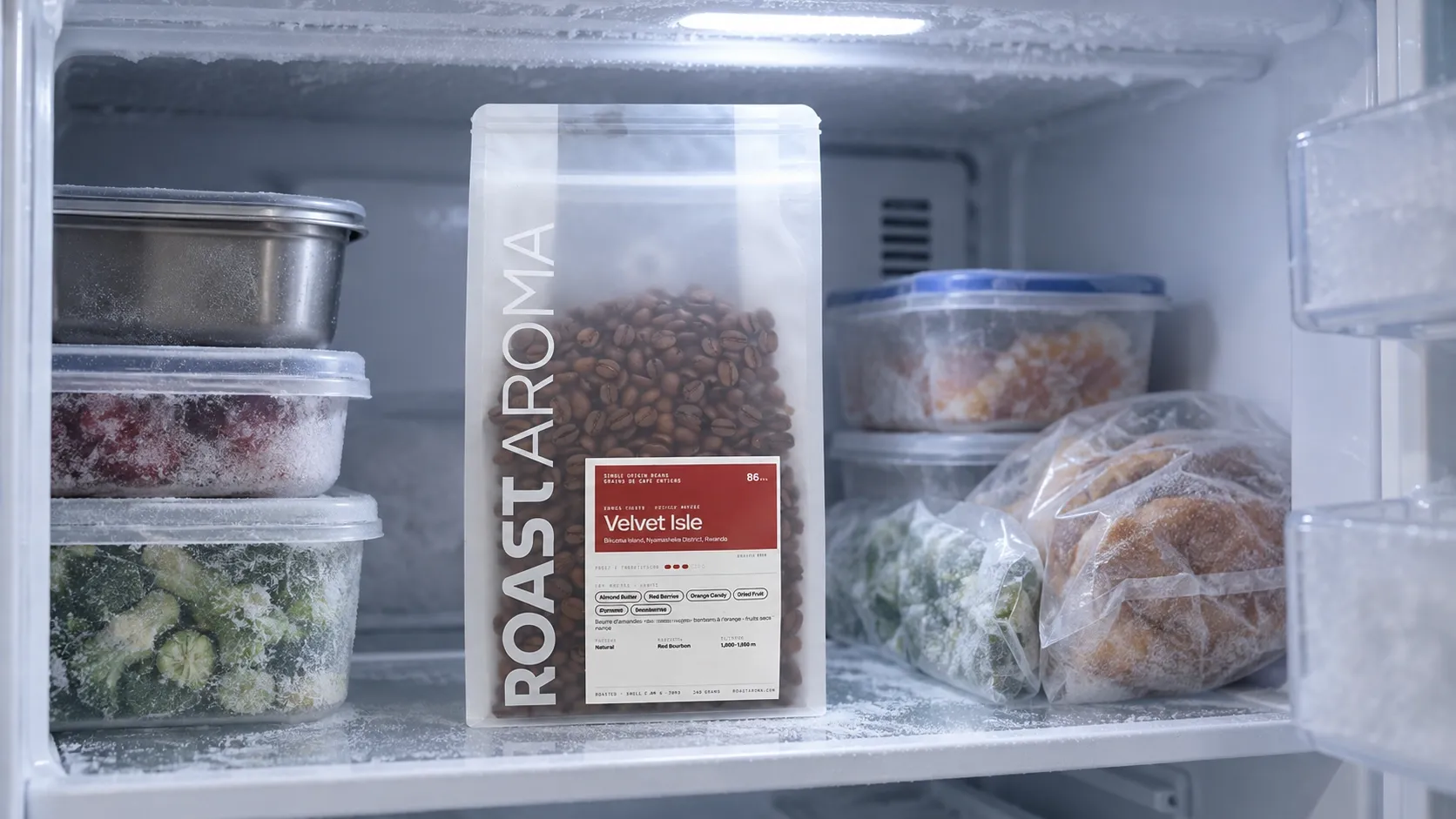
Seal it right. Tape the valve, press out air, reseal tightly, and slide the bag into a ziplock. The ziplock matters most when you take the bag out, not while it's frozen. Warm kitchen air hits the cold surface and condensates. That moisture can penetrate the bag, especially biodegradable ones with higher vapor transmission rates.
Portion before freezing. If you want to pull small amounts over time, divide into single-session doses first using small ziplocks or centrifuge tubes. Never open a frozen bag to scoop and refreeze. Each cycle lets humid air in, the moisture crystallizes, and the coffee degrades.
Thaw sealed. Let the bag or tube reach room temperature before opening: at least 12 hours for a full bag, about 45 minutes for a single dose. Opening while cold is exactly when condensation forms on the beans.
Grinding from frozen (optional). Research by Christopher Hendon and Maxwell Colonna-Dashwood found no structural damage to frozen beans. Some tasters noted brighter acidity from frozen grinds. Expect a finer particle size from the same grind setting (frozen beans shatter more easily), so dial in accordingly.
Freezing by roast level
Light roasts benefit most from freezing. They degass slowly through smaller pores, meaning they also lose volatiles slowly. A frozen light roast at -18°C holds remarkably well for months.
Dark roasts produce more CO2, degass faster, and age faster at room temperature. Freezing still helps, but freeze them soon after purchase for the best results.
How Long Does Roasted Coffee Actually Last?
A rough timeline, drawn from the research Hedrick summarizes and practical experience brewing through it.
Days 1 to 4 (rest phase). Beans are still releasing CO2 rapidly. Brewing now often produces uneven extraction and muted flavors, especially with light roasts. Let them rest. If your beans ship Monday and arrive midweek, the transit time itself acts as a rest period.
Days 5 to 14 (peak window). Most coffees hit their stride here. CO2 has settled enough for clean extraction and volatile aromatics are still abundant. Lighter roasts may peak later in this window (days 8 to 14); medium and darker roasts tend to peak earlier (days 5 to 10).
Weeks 3 to 4 (still good, declining). Flavors flatten. The bright top notes fade first. You can still brew a good cup, but the complexity is leaving. This is your last practical window to freeze what remains.
Week 5 and beyond (freezer territory). Oxidation and volatile loss compound noticeably. An unopened bag in a cool, dark spot is drinkable but muted. An opened bag is declining faster. Drink what you have and plan your next order.
A note on Canadian climate. Across Canada, forced-air winter heating pushes indoor humidity quite low, sometimes below 30%, which is actually favorable for coffee storage. Summer is the opposite: anywhere in Canada with humid summers (most of the country east of the Prairies) sees indoor humidity climb to 50 to 70%, accelerating moisture uptake in your beans. If you're storing bags through a Canadian summer, the ziplock-over-sealed-bag trick becomes especially worthwhile. Or just shorten your delivery frequency for the warmer months.
From Rested Bag to Great Cup
Proper storage gets your beans to the grinder in the best possible shape. When you're drinking roast-to-order coffee that arrives within days of roasting, you're already starting from the strongest position. The rest comes down to brew method, water, grind size, and ratio.
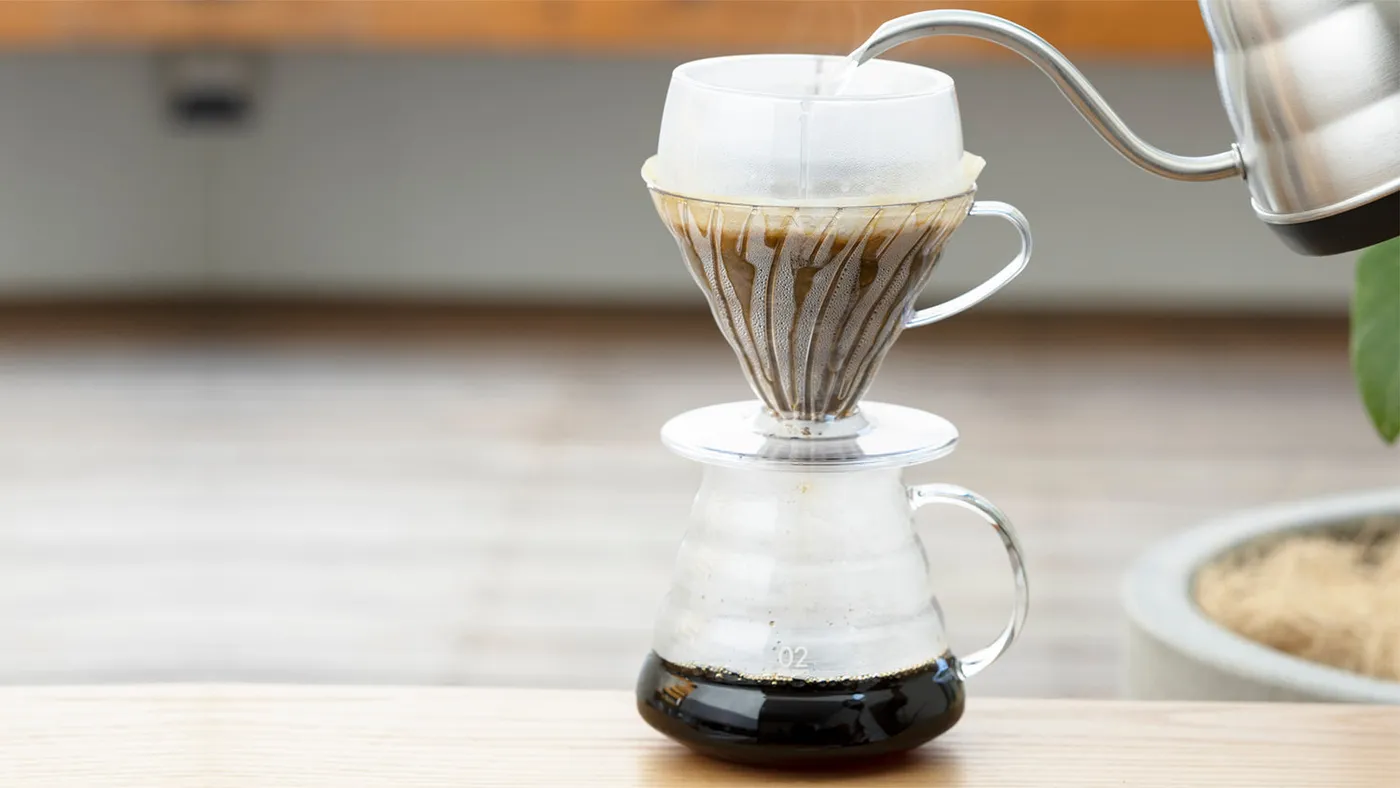
If you're into pour-over and want a recipe that handles light roasts well, Lance Hedrick's Switch recipe is a solid starting point. It's a hybrid immersion-percolation method that forgives a lot of variables and highlights origin character. Freshly stored beans make a bigger difference in espresso-based drinks than most people expect.
Quick-Reference Checklist
- Tape the valve on light roasts immediately; on dark roasts, after about a week of offgassing
- Press air out and check the seal every time you close the bag
- Double-bag with a ziplock if the seal feels loose or you plan to freeze
- Bag inside canister beats transferring beans if you own a Fellow Atmos or Airscape
- Drink within 2 weeks of roasting for peak flavor
- Freeze what you can't finish in 3 to 4 weeks: tape, seal, ziplock, freeze
- Portion before freezing. Thaw sealed to room temperature before opening
- Shorten delivery frequency in humid Canadian summers rather than perfecting your storage setup
Your Beans Deserve Better Than a Shelf
The research is clear: temperature controls everything. Freezing is the closest thing to a pause button for coffee freshness. But the simplest approach is matching your supply to your pace so storage barely enters the picture.
Ready to stop worrying about stale coffee? Build your own coffee subscription and dial in the cadence that fits how you actually drink. Pick the roast, the grind, the grams, and the frequency. Your beans get roasted the Saturday before they ship, anywhere in Canada.