Most caffeine charts give you a single number per cup. Health Canada's table, for example, lists 135 mg for a 237 ml cup of brewed coffee. That's fine as an average, but the cup is the least useful unit you can measure. The number that actually decides your caffeine is how many grams of coffee you brewed, and what you did to them.
James Hoffmann's caffeine experiment shows this better than any chart of caffeine content by brew method. He bought a caffeine analyzer (around $2,500 by his account, plus £7.50 of single-use chip and reagent for every test) and ran the comparison generic charts skip: same coffee, same dose, same extraction, brewed two ways. The results are in his video I Did Caffeine Analysis: Some Unexpected Results!, and they are the backbone of this guide.
We roast coffee for a living, so we want to do what the video doesn't: turn his numbers into a rule you can use at home, check them against two independent lab studies, and rank the levers that actually raise or lower the caffeine in your cup.
Same 18 g of coffee, two very different caffeine totals
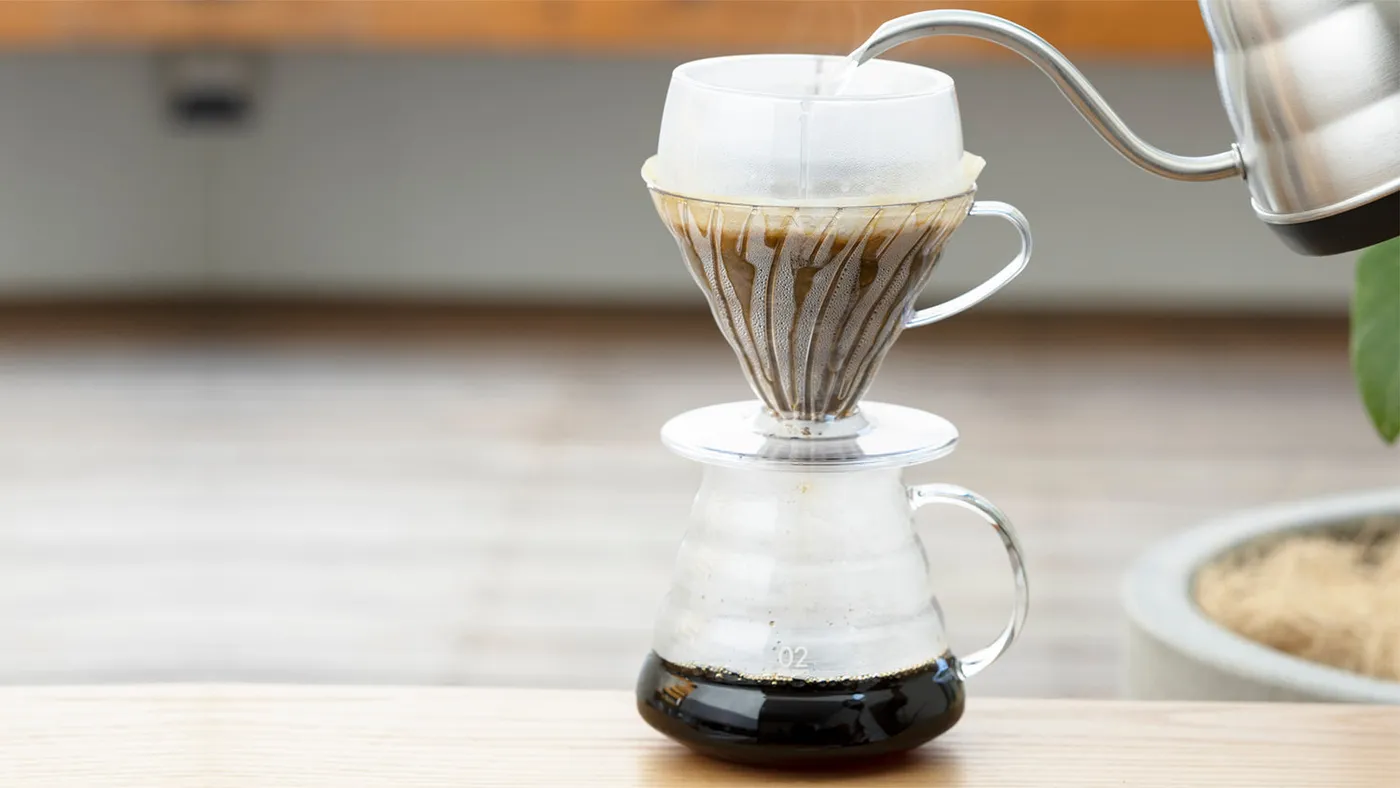
Here's the test. Hoffmann brewed 18 g of coffee as a double espresso, 36 g in the cup, extracting about 21% of the grounds. Then he brewed 18 g of the same coffee as a filter coffee with 300 ml of water, again extracting about 21%.
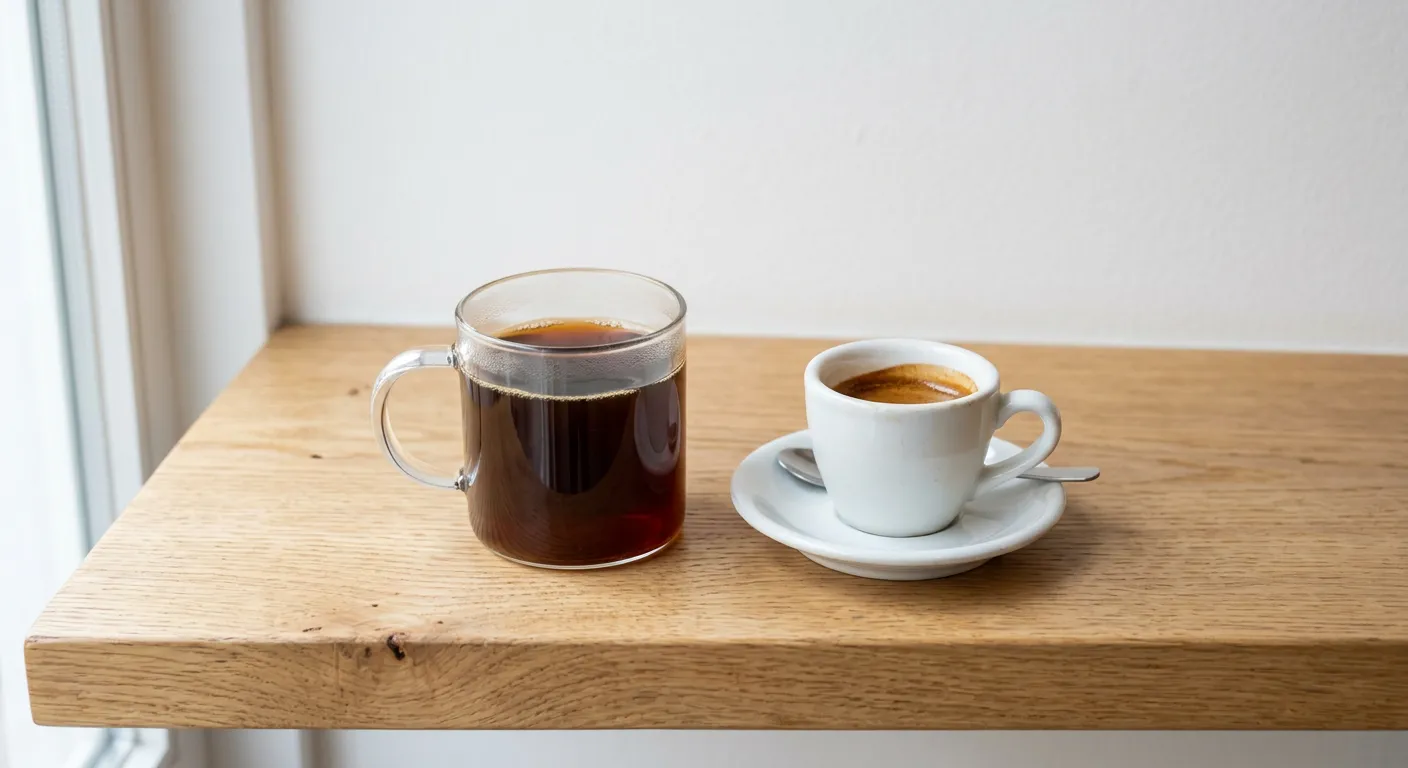
Same beans, same dose, same extraction. So how much caffeine is in espresso vs pour over? Here's what the analyzer found:
Double espresso (18 g in, 36 g out): 110 mg of caffeine
Filter coffee (18 g in, 300 ml of water): 170 mg of caffeine
That's 60 mg more from the same grounds, roughly 55% more. Hoffmann called it "nearly 50% more caffeine" and admitted it "absolutely blew my mind," because the extraction was identical.
It isn't a one-off. In 2017, chemistry students at the University of Newcastle in Australia measured five brew methods with lab equipment (HPLC) for Crema Coffee Garage, using a single Colombian coffee. As BeanScene reported, their espresso measured 4,200 mg of caffeine per litre and their pour over 692 mg. At the study's own serving sizes, 30 ml of espresso and 250 ml of pour over, that works out to about 126 mg for the espresso and 173 mg for the pour over. Different lab, different recipes, same direction.
That per-litre figure is also why espresso vs filter coffee caffeine gets misread so often. Espresso is far more concentrated, but nobody drinks a litre of it. Per drink the pour over wins, and in Hoffmann's same-dose test it wins per gram too.
The per-gram rule: about 9 mg for filter, about 6 mg for espresso
Divide Hoffmann's results by his 18 g dose and you get the most useful number in this article (our arithmetic, not his):
Filter coffee: about 9.4 mg of caffeine per gram of coffee you brew
Espresso: about 6.1 mg of caffeine per gram of coffee you brew
Multiply by your own dose and you have a working estimate:
- A 15 g pour over: about 140 mg
- A 20 g pour over: about 190 mg
- An 18 g double espresso: about 110 mg
- A 22 g double espresso: about 135 mg
Treat these as a ballpark, not a lab report. Hoffmann was clear that "coffee itself is a variable": the same pour over recipe measured anywhere from about 65 to 80 mg per 100 ml depending on which coffee he used. The rule gets you into the right neighbourhood, which is more than a one-number-per-cup chart can do.
It's also the easiest way to check yourself against Health Canada's caffeine guidance: up to 400 mg a day for healthy adults, and 300 mg if you're pregnant, breastfeeding or planning a pregnancy. At the filter rate, 400 mg is roughly 42 g of coffee a day, and 300 mg is about 32 g. As espresso, 400 mg is closer to 65 g, or three and a half 18 g doubles. (Hoffmann mentions 300 mg as the daily allowance in his video; Canada's guideline for healthy adults is 400.)
Once you know your daily grams, you know two things at once: roughly how much caffeine you drink, and how much coffee to order. Two 18 g pour overs a day is 36 g, which works out to about 340 mg of caffeine and about 250 g of beans a week. That same grams-per-day number is how we size orders to stay inside the freshness window, and it's what a pour over coffee subscription should be built around: your real weekly grams, not a standard bag size.
What that caffeine costs at home versus the café
The per-gram rule makes one more comparison easy. At the 350 g prices on our lineup today ($18.52 to $32.69, depending on the coffee), an 18 g dose costs about $0.95 to $1.68 in beans. Brewed as a pour over, that's roughly 170 mg of caffeine. Most café lattes are built on a double shot, so they carry about the same caffeine as the double you'd pull at home, at several times the price. If you've ever wondered how much is a coffee in Canada once tax and tip land, we broke that down separately. The short version: at the café you're paying for rent, labour, milk and the cup, not for caffeine.
Light roast vs dark roast caffeine: both camps are half right
Ask whether dark roast has less caffeine and you'll get two confident answers. One camp says yes: caffeine sublimates (turns straight from solid to gas) at the top end of roasting temperatures, so a longer, hotter roast drives some of it off. The other camp says dark roast has more, because it tastes stronger. A lot of the advice in between settles on "it's the same by weight."
Hoffmann tested it directly. He took one coffee and roasted three samples: a slightly underdeveloped light roast, a normal medium roast, and a dark roast taken into second crack. He brewed each as a pour over to the same extraction level and measured the caffeine:
Light roast: 62 mg per 100 ml
Medium roast: about 67.5 mg per 100 ml
Dark roast: 72 mg per 100 ml
Dark came out about 16% higher than light. His explanation has two parts. Roasting longer makes beans lighter and less dense, so a dose of dark roast contains more beans: going from medium to dark, he needed about 7% more beans to make up the same 10 g. And darker coffee is more porous, which he thinks makes it "even easier to extract every scrap of caffeine that's in there."
Now the other side. A 2024 study in Scientific Reports by Lindsey and colleagues at Berry College and Drexel University roasted two Ethiopian coffees to five roast levels and measured 90 AeroPress brews with lab equipment. Their findings sound like the opposite of Hoffmann's. They aren't:
- Same recipe for every roast: darker roasts generally ended up with less caffeine in the cup than light and medium roasts. Darker coffee extracted less overall, and the data suggests some caffeine was lost late in the roast.
- Same extraction for every roast: darker roasts had more caffeine, which is exactly what Hoffmann measured.
- Where the cup peaked: in their 10-minute brews, caffeine topped out in the light-to-medium range and fell off for the darkest roasts.
In the authors' own words, "extraction yield seems to play a more impactful role on resulting caffeine content in brewed coffee than the degree of roast alone."
So does dark roast have less caffeine? It depends on how you brew:
If you use one recipe for every coffee: roasts in the light-to-medium range tend to come out on top, and very dark roasts come out lowest.
If you dial each roast in to taste (adjusting your grind until it tastes right): darker roasts give a bit more caffeine.
If you measure with a scoop instead of a scale: dark roast beans are less dense, so a scoop of dark roast weighs less. That can tip the result back toward lighter roasts.
Each camp is right about its own situation. The more useful takeaway is the size of the swing: about 16% from light to dark in Hoffmann's test, against 55% from switching brew methods. Roast is a small caffeine lever, so choose it for flavour. If you're not sure where your taste sits, start with choosing a roast by what you already like to eat. We roast our coffees to order anywhere from Light Medium to Dark depending on the bean, so whether you want a light roast coffee subscription or a dark roast coffee subscription, you're choosing a flavour, not a caffeine level.
How to maximize caffeine in coffee (or cut it back): the levers, ranked
Put Hoffmann's tests next to the two studies and you can rank the things that change caffeine by how much they actually move the number.
1. Dose. Caffeine scales with the grams you brew. Going from 15 g to 20 g is a third more caffeine before you change anything else. This is the biggest and most reliable lever you have.
2. Brew method. From the same 18 g, filter gave about 55% more caffeine than espresso in Hoffmann's test, and the Newcastle pour over beat their espresso per serve.
3. The beans themselves. Robusta has roughly twice the caffeine of Arabica, as Hoffmann points out. When he brewed a V60 with Lavazza, a supermarket blend with some Robusta in it, it measured over 100 mg per 100 ml, against about 65 to 80 for the specialty pour overs. In his words, "specialty is less caffeine than cheaper fresh coffee."
4. Roast level. Up to about 16% in Hoffmann's test, and the direction depends on your recipe, as covered above.
5. Espresso ratio. Hoffmann added a note to the video: a longer shot, like a lungo at a 3 to 1 ratio, gives "more caffeine for the same overall extraction." Not as much as a pour over, but more than a standard double.
6. Steep time. Close to zero. In his AeroPress test (12 g of coffee to 200 g of water), he varied the steep from 30 seconds to 20 minutes. Overall extraction kept climbing, but caffeine flattened out after about two minutes. A long French press or AeroPress steep is for flavour, not a bigger buzz. He only tested single steeps, so recipes that drain and add fresh water in stages, like the Gong Fu Hario Switch method we tried, sit outside what his data covers.
7. Origin and altitude. Small. Hoffmann found Ethiopian coffees came in "fractionally" lower, and he offers a broad rule of thumb that higher-grown coffee tends to carry less caffeine, with plenty of exceptions.
Two popular tips fall apart against this list. Grinding finer only helps as far as it raises extraction: espresso uses the finest grind of all and still gave the least caffeine, most likely because its contact time is so short. And cold brew isn't automatically strong or weak. In the Newcastle study the cold brew concentrate measured 2,240 mg of caffeine per litre, yet at the study's 60 ml serving that's about 134 mg. It all depends on how much concentrate you pour.
Maximum caffeine: the protocol
- Brew it as filter coffee. Same beans, roughly 55% more caffeine per gram than a shot.
- Use a generous dose. Every extra gram adds about 9 mg. A 20 g mug lands around 190 mg.
- Extract fully. In filter brewing, caffeine rises in step with everything else you extract. As Hoffmann puts it, "The more coffee you extract from the grounds, the more caffeine you get with it." Grind fine enough that the cup tastes sweet and complete, not thin and sour.
- Pick a medium roast or darker, dialled in to taste. Both data sets point here, as long as you adjust your grind for each coffee instead of using one setting for everything.
- Skip the marathon steeps. Past about two minutes of steeping, Hoffmann saw no extra caffeine.
- Know the other big lever. Robusta carries roughly twice the caffeine of Arabica, at the cost of the flavour you're probably buying specialty coffee for.
Minimum caffeine without switching to decaf
In Hoffmann's same-dose test, espresso pulled about a third less caffeine than filter from the same grounds, which makes it the lowest caffeine coffee brewing method he compared. Here's how to use that, and the other levers, to cut back without giving up your coffee:
- Make it espresso-style. Same grams, less caffeine. RoastPlan grinds for every method except espresso, so for this one you'll want whole beans and a grinder at home.
- Keep the shot short. In espresso, caffeine lags behind the rest of the extraction and speeds up toward the end of the shot. A standard 2 to 1 double carries less than a lungo, and by the same logic a shorter shot carries less again.
- Drop the dose. A 12 g pour over lands around 110 mg, against about 170 mg for 18 g.
- Go half-caf. Mix a decaf into your regular coffee at whatever ratio you like. Under Canada's food standards, decaffeinated coffee can contain no more than 0.1% caffeine, so the 9 g decaf half of an 18 g dose holds at most 9 mg of caffeine in the grounds. A 50/50 pour over lands at roughly half your usual caffeine.
- Don't count on roast. The direction flips depending on whether you keep one recipe or dial each coffee in, and the swing is small either way. Pick roast for taste.
And if you ever want the floor: an 18 g dose of decaf holds at most about 18 mg of caffeine, and less than that ends up in the cup. Health Canada's table lists just 3 mg for a 237 ml cup of decaf. Moonrest, the coffee behind our decaf coffee subscription, is a Swiss Water decaf from Honduras, and it can sit in the same plan as your regular coffee with its own amount, which makes the half-caf route easy.
The most surprising number: instant coffee. Hoffmann had long told people that instant carries more caffeine, since most of it is made with Robusta. Then he measured it. Made the way the Nescafé Gold label suggests (1.8 g in 200 ml of water), instant came in just under 40 mg per 100 ml. Made to filter strength (3 g in 200 ml), it reached about 60. Typical specialty pour overs measured around 80. Even the harshest cheap instant he could find hit only 55 mg per 100 ml at label strength. "This has definitely been misinformation I've spread," he said. "I apologize for this now." Health Canada's own table points the same way: 179 mg for a 237 ml cup of filter drip coffee, against 76 to 106 mg for instant. Instant makers extract far more from their coffee and then tell you to use very little of it. If you switched from instant to fresh coffee and feel more wired, a matching mug can carry about twice the caffeine. Use fewer grams, not fewer cups, to get back to your old level.
Why lattes aren't lower in caffeine (and why espresso leaves some behind)
Milk adds volume, not caffeine. A latte, cappuccino or flat white carries exactly the caffeine of the shots inside it. Hoffmann's 18 g double measured 110 mg, and it's still 110 mg whether you drink it as a 36 g shot or stretch it into a large latte. So a latte isn't lower in caffeine than the espresso inside it. What makes it lower than a pour over is the espresso itself.
Why does espresso leave caffeine behind? Hoffmann collected shots in small fractions and measured each one. In filter coffee, caffeine came out in step with everything else. In espresso, "there's a big lag in caffeine extraction in the early phases and then it picks up speed." The lag was even stronger with a large-burr grinder (an Option-O P100) than with a Niche. His best guess is contact time: a shot may simply be too quick to pull out all the caffeine, even though it's long enough to pull out the flavour.
That's also why a lungo, run to about three times the dose in the cup instead of two, picks up more caffeine for the same overall extraction. If you want a little more from your milk drinks without changing methods, pull a longer shot.
If espresso is your daily method, one practical note: RoastPlan grinds for every method except espresso. Espresso needs a fine grind adjusted shot to shot on your own grinder, so order whole beans and grind right before you pull.
Putting it to work
Want more caffeine: brew filter, weigh a generous dose, extract fully, and choose a medium roast or darker dialled in to taste.
Want less: brew espresso-style or use a smaller dose, keep shots short, or go half-caf with a decaf.
Want to know where you stand: weigh your coffee. Grams times 9 for filter, times 6 for espresso, then check the total against Health Canada's 400 mg.
Every one of those choices gets made before the coffee is roasted, not after. With a coffee subscription built around your grams, you pick the coffee, the roast level, the grind for your brewer and the exact amount for each delivery. You can change any of it until 10 a.m. Eastern time on the Saturday before each roast, your card isn't charged until roast day, and we deliver anywhere in Canada. Set it to match your caffeine goal, then adjust as your routine changes.
Sources
- James Hoffmann, I Did Caffeine Analysis: Some Unexpected Results!, YouTube, December 2022
- University of Newcastle and Crema Coffee Garage caffeine study, reported by BeanScene, 2018
- Lindsey, Williams, Burgess, Moore and Splichal, Caffeine content in filter coffee brews as a function of degree of roast and extraction yield, Scientific Reports, 2024
- Health Canada, Caffeine in foods
- Canadian Food Inspection Agency, Canadian Food Compositional Standards, Volume 5 (Coffee), section 5.1.3